
In all our courses, the starting point is that everyone must be able to follow them, including employees who do not often work with a computer. That is why we keep the approach simple and recognisable.
Simple, visual and repetitive
- Simple texts: short sentences and clear words, focused on daily work.
- Images and pictograms: photos of the workplace and familiar safety signs make the content concrete.
- Repetition: important topics come back several times. Just like learning a language, working safely only sticks through frequent repetition and practice.
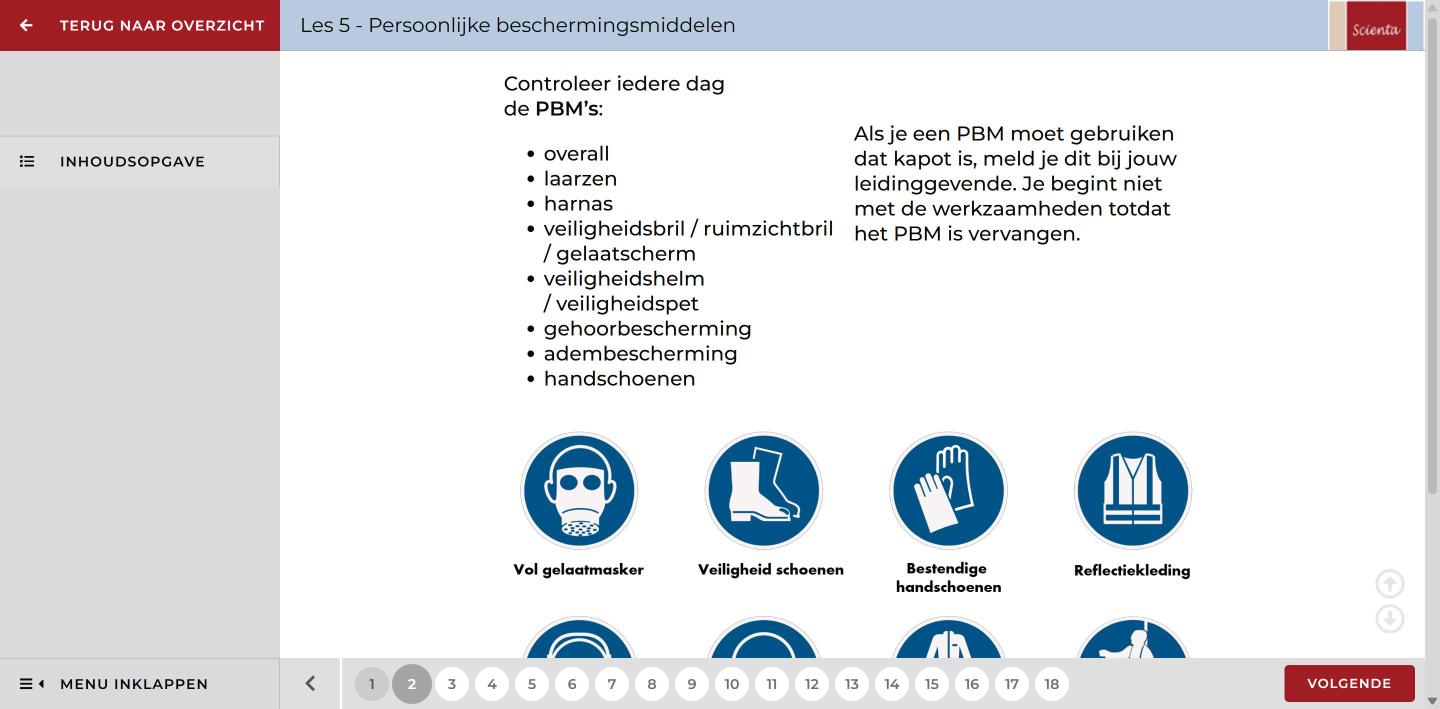
Practice during the lesson
Each lesson contains practice questions, such as true/false, multiple-choice and fill-in-the-blank questions. Participants immediately see whether their answer is correct, so they can check whether they have understood the lesson or should go through a part again.
From knowledge to behaviour
In our Behaviour Based Safety courses, it is ultimately about behaviour in the workplace. That is why the training consists of two parts:
- a theoretical part, concluded with a test;
- a practical assessment: the supervisor observes the employee during daily work using an assessment form and discusses the outcome with them.
This keeps points for improvement from the practical assessment in focus. We recommend repeating the training regularly; for tank cleaning companies, SQAS requires the BBS training to be followed at least once every three years.
Course material
Scienta does not provide course books or other paper materials. Where needed, such as the practical assessment form, documents can be downloaded within the training.